The Abbey Way
50 mile Pilgrimage
Lancaster
to
Furness Abbey
The Antei-ji Abbey Way is a 50-mile pilgrimage through the rich and living contemplative heritage of Lancashire and Cumbria, following the shores and historic crossings of Morecambe Bay from Lancaster to Furness Abbey.
Beginning at Antei-ji Zen Temple in Lancaster, the Way sets out from a place of living Buddhist practice and follows a remarkable thread through almost 1,500 years of monastic history. Along the route, the pilgrim encounters the remains of medieval abbeys and priories, ancient holy places, forgotten communities and landscapes that have been shaped for centuries by people who chose to devote their lives to something beyond themselves.
The Way begins with Buddhism as it is practised in Britain today, and then leads into the Christian contemplative traditions that have shaped this landscape for more than a thousand years. From the monastic houses of the medieval period, we travel further back to the Celtic Christian communities that emerged around the shores of Morecambe Bay and across the northern counties. These early communities were often small, remote and deeply connected to the natural world.
As the pilgrimage unfolds, the distinction between past and present begins to soften. The ruined walls of an abbey are no longer simply historical monuments. The landscape becomes a record of human searching for God. The Antei-ji Abbey Way therefore asks us to walk with a different kind of attention.
For some pilgrims, the journey may be an exploration of faith. For others, it may be an encounter with history, an opportunity to discover the roots of monasticism in the North West, or simply a chance to walk deeply through a beautiful landscape.
For everyone, it is an invitation to slow down.
The Way can be walked as a Buddhist practice of mindfulness and awakening, as a Christian pilgrimage through the deep Christian heritage of the North, or simply as an encounter with the extraordinary spiritual history of this country. No particular religious faith is required. What is required is only a willingness to walk, to pay attention and to encounter the landscape with an open mind.
For all, it is an opportunity to experience a journey where the veil between heaven and earth is exceedingly thin.
Antei-ji Temple, Lancaster
The pilgrimage begins at Antei-ji Zen Temple in Lancaster Cemetery. Before taking the first steps, pilgrims begin with a period of silent meditation. The journey therefore begins not with movement, but with stillness.
Dalton Square, Lancaster
From Antei-ji, the Way leads into the heart of Lancaster and to Dalton Square, remembering the Dominican monastery of the Blackfriars, founded here in 1260. For almost 300 years the friars served the people of Lancaster, preaching, teaching and caring for the community.
The monastery itself has long disappeared, but its place in the life of medieval Lancaster remains. As we walk through the modern city, we are walking through a landscape once filled with the sounds and rhythms of monastic life.
Lancaster Priory
From Dalton Square the Way continues to Lancaster Priory. The present priory dates from 1094, but the story beneath it reaches back much further. Traces of a church from the sixth century remain, taking us into the earliest centuries of Christianity in the North of England.
Here, the layers of history begin to reveal themselves. The medieval church stands upon an older Christian landscape, reminding us that the search for God in this part of the country began long before the great medieval monasteries were built.
St Patrick’s Chapel, Heysham
From the Priory, the pilgrimage turns towards the coast and Heysham. At St Patrick’s Chapel, high above Morecambe Bay, we encounter one of the oldest Christian sites in northern England.
Its origins belong to the Celtic Christian world of the sixth century, around the time that St Columba was establishing the great monastery of Iona. Beside the ancient chapel and its rock-cut graves, with the wide expanse of Morecambe Bay before us, the extraordinary antiquity of the landscape becomes tangible.
This is a place where it is easy to imagine the early Christian communities who came here seeking solitude, prayer and a life close to the natural world.
Lancashire Coastal Way
From Heysham, the Way opens out onto Morecambe Bay.
The pilgrim follows the Lancashire Coastal Way northwards, walking beside the changing waters of the bay towards Arnside. The character of the pilgrimage changes here. The ancient churches and enclosed spaces of Lancaster and Heysham give way to open sky, shore, salt marsh and the ever-changing landscape of the bay.
At Arnside, the journey continues by train around the head of the bay to Grange-over-Sands, following the historic route between Lancashire and Cumbria.
For centuries, Morecambe Bay has been both a meeting place and a formidable landscape to cross. The bay is not simply scenery along the Way; it is part of the pilgrimage itself.
Cartmel Priory
From Grange, the Way continues to Cartmel Priory.
The priory we see today was founded in 1189 and remains one of the finest surviving medieval religious buildings in the region. But once again, the story reaches further back. In 674, King Ecgfrith granted land here to St Cuthbert, and the original church was dedicated to St Michael.
Standing at Cartmel, the pilgrim encounters layer upon layer of Christian history: the ancient Christian landscape, the early community associated with St Cuthbert, and the medieval priory that grew into the building we see today.
Conishead Priory
The journey then brings us to Conishead Priory, founded as an Augustinian priory in 1188.
Here something remarkable happens. The medieval priory is no longer simply a remnant of the past. Today Conishead is home to the Manjushri Kadampa Meditation Centre, a living Buddhist community.
The pilgrimage that began at Antei-ji therefore encounters another Buddhist community within the walls of a former Christian monastery. The traditions are different, but the continuity of contemplative life is striking: a place established for religious practice centuries ago remains a place of spiritual practice today.
Furness Abbey
From Conishead the Way reaches its final destination: Furness Abbey.
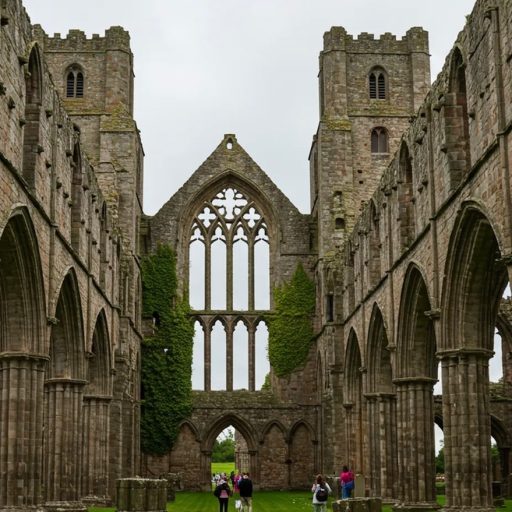
Founded in 1123, Furness became one of the greatest Cistercian monasteries in England. For centuries it was a vast centre of prayer, work, learning and hospitality, with a community whose influence extended across much of the surrounding region.
Today its magnificent ruins remain, silent and open to the sky. The scale of the surviving buildings gives some sense of the community that once lived here and of the extraordinary world that grew around the abbey.
And here, among the ruins of Furness, the Antei-ji Abbey Way comes to an end.
The landscape has changed. The traditions have changed. The centuries have passed. But the pilgrimage has followed a single thread: the human desire to step aside from ordinary life and give ourselves to something deeper.