The Great Pilgrim Way
520 Mile Pilgrimage
Lancaster
to
Iona Abbey
The Antei-ji Great Pilgrim Way is a 520-mile pilgrimage across England and Scotland, ending on the sacred island of Iona. It is the longest and most demanding of the Antei-ji pilgrimages, but its length is part of its purpose. This is not simply a long-distance walk. It is a journey deep into the contemplative memory of Britain.
The journey begins at Antei-ji Zen Temple in Lancaster, with silence. From there it follows the Monastic Way northwards to Lindisfarne, before continuing across the Scottish border and into a much older landscape of Celtic Christianity. Along the way, the pilgrim encounters medieval monasteries, ancient holy places, remote caves and islands, and living communities where Christian and Buddhist contemplative traditions continue to be practised today.
But the Great Pilgrim Way is about more than connecting these places. It is about following a thread. At Antei-ji, that thread begins in living Zen practice: sitting in silence, training the mind and deliberately shaping a life around awakening. At Lindisfarne, the pilgrim encounters the Christian contemplative tradition of St Aidan and St Cuthbert — people whose lives were likewise shaped by prayer, discipline, solitude and service.
Beyond Lindisfarne, the journey continues into Scotland and towards the older Celtic world from which much of the spiritual landscape of the North emerged. At Whithorn, St Ninian’s Cave and other ancient places, the pilgrim enters a landscape in which Christianity was first taking root among the peoples of northern Britain At Samye Ling, the thread takes another remarkable turn. Here, within the Scottish landscape, stands a living Tibetan Buddhist community. Like Antei-ji and Throssel Hole Abbey, it is not a relic of the past but a place where people continue to devote themselves to meditation, study, discipline and spiritual practice.
As the journey continues north and west, the landscape becomes increasingly Celtic. The great medieval churches and monasteries give way to older foundations, remote landscapes and places associated with the saints who carried Christianity across Britain. At Glasgow Cathedral, the pilgrim encounters another layer of this history before turning westwards towards the Highlands.
And then comes Iona. Iona is not simply the end of the journey, it is the place towards which the whole pilgrimage has been moving. In AD 563, St Columba arrived on the island and established his monastery. From this small and remote community, a spiritual tradition developed that would have an extraordinary influence across Scotland and northern Britain. Iona became a place of prayer, learning, mission and pilgrimage — a centre from which monks travelled out into the wider landscape.
To arrive there after 520 miles is therefore to arrive at one of the great sources of Britain’s contemplative memory. In a sense, it is a journey upstream. The further we travel, the further we move into the deep memory of the land. The Great Pilgrim Way gives us the rare opportunity to spend enough time walking to encounter that world for ourselves.
Five hundred and twenty miles changes the nature of a journey. There is time to become tired, to become quiet, to lose the urgency of ordinary life. There is time for the landscape to become familiar, for the mind to settle and for pilgrimage to become something more than travelling from one place to another. Where possible, pilgrims are encouraged to stay within living contemplative communities, sharing something of their rhythm of prayer, meditation, work and hospitality.
The Great Pilgrim Way is a journey upstream through Britain’s contemplative memory — from a living practice today, towards the ancient source.
Antei-ji Temple, Lancaster
A pilgrim’s departure.
The Great Pilgrim Way begins at Antei-ji Zen Temple. Before the journey begins, the pilgrim sits in silence, gathering attention for the 520 miles ahead. The first step is therefore not simply a step onto a path. It is a deliberate leaving behind of ordinary life and an entering into pilgrimage.
Dalton Square, Lancaster
From Antei-ji, the Way passes through Dalton Square, remembering the Dominican monastery of the Blackfriars, founded here in 1260. For nearly 300 years the friars served Lancaster, preaching, teaching and caring for the community. The monastery has disappeared, but its memory introduces the pilgrim to the long tradition of religious communities that have shaped this landscape.
Lancaster Priory
The Way continues to Lancaster Priory, whose present building dates from 1094. Around the Priory are traces of a much older church dating from the sixth century. Here the pilgrim begins to encounter the deep layers of Britain’s Christian past, reaching back towards the earliest communities of the North.
St Patrick’s Chapel, Heysham
From Lancaster, the Way turns towards St Patrick’s Chapel at Heysham. One of the oldest Christian sites in Northern England, its origins belong to the sixth-century Celtic Christian world, around the time of the founding of Iona. The ancient chapel, rock-cut graves and extraordinary view across Morecambe Bay offer a first glimpse of the spiritual landscape into which the pilgrimage is now travelling.
Cartmel Priory
The Way continues into Cumbria and to Cartmel Priory, beautifully preserved since its foundation in 1189. The story reaches back further still. The original church was dedicated to St Michael and was built shortly after King Ecgfrith granted land here to St Cuthbert in 674. At Cartmel, the pilgrim encounters the first of many places connected with Cuthbert, whose life and spiritual legacy will increasingly shape the journey northwards.
Conishead Priory
Founded as an Augustinian priory in 1188, Conishead offers another remarkable meeting of past and present. The former priory is now home to the Manjushri Kadampa Meditation Centre.
Furness Abbey
Founded in 1123, Furness became one of England’s greatest Cistercian monasteries. For centuries, its monks followed the disciplined rhythm of Cistercian life: prayer, work, study and communal living. The magnificent ruins that remain today allow the pilgrim to glimpse the scale of the community that once occupied this place.
Shap Abbey
From Furness, the Way turns eastwards and crosses into the high fells and the Eden Valley. Here stands Shap Abbey, a quiet Premonstratensian foundation established in 1190. Its remote setting offers a different experience of medieval monastic life — away from the great centres, surrounded by open country and the changing weather of the fells. The pilgrimage is now approaching the Pennines.
Throssel Hole Buddhist Abbey
Crossing the Pennines brings the pilgrim to Throssel Hole Buddhist Abbey, a modern Soto Zen monastery founded in 1972. After following the remains of Christian monasteries for hundreds of miles, the pilgrim now encounters monastic life in the present. Throssel Hole is a working Buddhist community, where meditation, study, work and communal practice continue today. There is possibly an opportunity to stay for two nights and experience something of the rhythm of life within a contemporary Zen monastery. The journey now turns towards the ancient Christian heartlands of Northumbria.
Durham Cathedral
Durham Cathedral is one of England’s great treasures. Built upon the earlier White Church of Saxon times, established in 995, the cathedral became the great guardian of the shrine of St Cuthbert. His presence has accompanied the pilgrimage since Cartmel; here the pilgrim encounters the place where his memory became one of the central spiritual forces of northern Christianity.
Minsteracres Christian Retreat Centre
From Durham, the Way continues to Minsteracres, a Catholic retreat centre run by the Passionists. Pilgrims may spend a night here before continuing towards Hexham, experiencing another form of living Christian contemplative life: retreat, prayer, hospitality and community.
Hexham Abbey
Hexham Abbey was founded by St Wilfrid in 674, a generation after Aidan’s mission began at Lindisfarne. It became one of the great churches of the North and remains a powerful reminder of the extraordinary flowering of Christianity across Northumbria during the seventh century. The pilgrim is now moving through the landscape in which Aidan, Cuthbert, Wilfrid and their communities lived, travelled and practised their faith.
St Cuthbert’s Cave
The Way then leaves the great churches behind and enters the open landscape. St Cuthbert’s Cave became a place of refuge during the Viking invasions, when Cuthbert’s community carried his body from Lindisfarne in search of safety. Here the story of Cuthbert becomes very physical. The community was no longer protected by monastery walls. They were on the road, carrying their saint through a dangerous and uncertain landscape. The pilgrim continues in their footsteps.
Lindisfarne Abbey and St Cuthbert’s Island
The first great destination of the journey is Holy Island. Here, in AD 635, St Aidan founded the monastery of Lindisfarne. From this small island community, Christianity spread throughout Northumbria, and Lindisfarne became one of the great centres of learning, prayer and missionary activity in early Britain. St Cuthbert became prior and later bishop here. His life and death would make Lindisfarne one of the most important destinations of pilgrimage in the North. For pilgrims wishing to remain longer, there is an optional two-night stay at Marygate House. But the Great Pilgrim Way does not end here. It turns north into Scotland.
Old Melrose Abbey
The journey crosses the border to Old Melrose, where St Aidan founded a monastery in AD 635 before travelling to Lindisfarne. It was here that St Cuthbert entered monastic life under Abbot Eata, before later moving to Lindisfarne. The significance of this place is difficult to overstate. Aidan, Cuthbert and the monastic tradition of Northumbria meet here in a single landscape.
From Old Melrose, the pilgrim enters a long period of walking alone through the wilderness of the Border Country. This is perhaps one of the most important transitions in the entire pilgrimage. The great abbeys and churches fall away. The pilgrim enters open country and begins to experience something of the landscape in which the early Celtic monks themselves travelled. Their tradition included peregrinatio pro Christo — wandering for Christ. Leaving the familiar behind and placing oneself in God’s hands, the pilgrim deliberately became a stranger, travelling without knowing exactly where the journey would lead.
For a modern pilgrim, these long solitary stretches offer an opportunity to experience something of that ancient spirituality: not by recreating it, but by allowing the landscape, silence and uncertainty to become part of the practice.
Samye Ling Tibetan Buddhist Centre
The wilderness eventually gives way to another living expression of contemplative life at Samye Ling Tibetan Buddhist Centre. Here, in the Scottish landscape, pilgrims have the opportunity to encounter a Tibetan Buddhist monastery and community. A possible two-day stay can provide time to step out of the rhythm of walking and into another rhythm of meditation, teaching, community and hospitality. Once again, the ancient thread meets a living tradition.
Whithorn Priory — Candida Casa
The Way then turns south-west towards Whithorn. Here the pilgrim honours St Ninian, whose mission predates Columba by well over a century. Whithorn, traditionally regarded as the earliest Christian centre in Scotland, is associated with the Candida Casa — the “White House” — established around AD 397. Ninian represents an even earlier layer of Britain’s Christian story, reaching back before the great Celtic monasteries of Aidan, Cuthbert and Columba.
St Ninian’s Cave
From Whithorn, the Way continues to St Ninian’s Cave, traditionally associated with the saint’s personal retreat. It is a fitting place to pause. After so many monasteries and great churches, the pilgrim comes once again to solitude: a small, remote place associated with a person seeking a life apart for prayer. The journey repeatedly returns to this tension between community and solitude.
Crossraguel Abbey
The Way turns north again to Crossraguel Abbey, founded in 1244. This magnificent Cluniac Benedictine abbey continues the thread of medieval monasticism encountered earlier at Furness and Shap. The architecture and landscape have changed, but the fundamental rhythm of monastic life — prayer, work, community and devotion — remains recognisable.
Paisley Abbey
From Crossraguel, the journey continues to Paisley Abbey, founded in 1163 and one of Scotland’s great medieval abbeys. By now the pilgrim has travelled through centuries of Britain’s monastic history, from the earliest Christian foundations to the great medieval houses and the living Buddhist communities of the present.
Glasgow Cathedral
Glasgow Cathedral stands over the traditional burial place of St Kentigern, or Mungo, one of the great saints of the early Scottish Church. It is unquestionably one of Britain’s great pilgrimage destinations. Here, amid the architecture of the medieval cathedral, the pilgrim encounters another of the ancient spiritual figures who helped shape the Christian landscape of Scotland. From Glasgow, the character of the journey changes once again.
Loch Lomond and Crianlarich
The Way leaves the cities behind and follows the old route along Loch Lomond and through Crianlarich. This is one of Scotland’s classic walking landscapes. The great loch, mountains and changing weather mark the beginning of the final transition from the settled Lowlands into the wild Highlands. The journey is drawing towards the sea.
Oban
At Oban, the pilgrim leaves the mainland and takes the ferry to Mull. The crossing itself becomes part of the pilgrimage. After hundreds of miles on foot, the sea finally carries the pilgrim towards the island that has been waiting at the end of the Way.
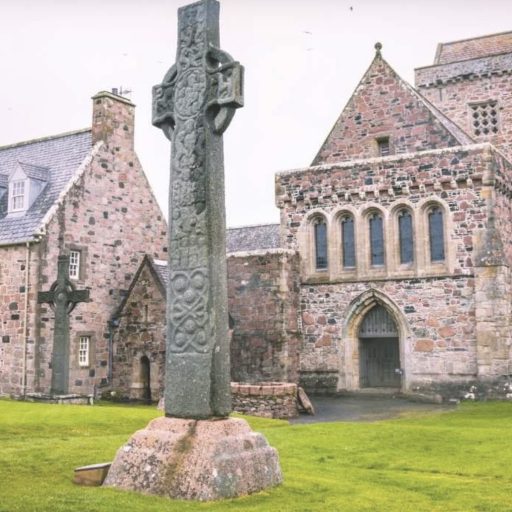
Iona Abbey
The Great Pilgrim Way ends on Iona. In AD 563, St Columba arrived on the island and established his monastery. Iona became a vibrant missionary and contemplative centre, sending monks throughout Scotland and northern Britain. It was a place of prayer, learning, community and pilgrimage.
And here another extraordinary connection emerges. St Aidan, whose monastery the pilgrim encountered at Lindisfarne, was a monk of Iona before travelling east to continue the Christian mission in Northumbria. He would establish the monastery on Holy Island and play a central role in the conversion of the North.
The journey has therefore come full circle. From Iona came Aidan. From Aidan came Lindisfarne. Through Lindisfarne we encounter Cuthbert. And through the long journey from Antei-ji to Iona, the pilgrim has followed the movement of a spiritual tradition across Britain as a living thread passed from one person and one community to another.
At Iona, the pilgrim can remain for a further two days, allowing the journey to settle into the landscape rather than ending abruptly with arrival. After 520 miles, there is time to stop. To sit. To look out across the sea. And perhaps to understand that the pilgrimage was never simply about reaching Iona. The thread that you have walked will continues throughout your whole life.