Let's Get
Started
A new FREE booklet
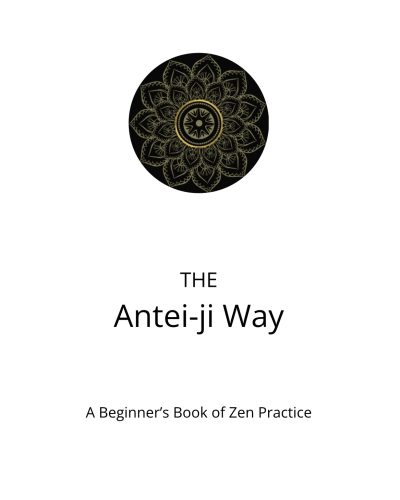
by Venerable Jitei Bochi White
The Antei-ji Way is a short introduction to Zen practice.
It is an exploration of the Buddha, the Dharma and the Sangha, and of the simple practices at the heart of the Antei-ji way.
It is an invitation to discover for yourself what happens when you begin to live life a little more simply and wholeheartedly.
The booklet is offered freely as a pdf
43 pages · Free PDF
Begin Where You Are.
Sit Down.
Be Still.
This is the start of something real. Zen doesn’t promise to fix you but it teaches you how to stay completely with life.
What's asked of you
- A willingness to show up daily to your life, even in small ways.
- A commitment to sit zazen every day.
- An interest in turning toward your life, rather than away from it.
- A respect for silence and simplicity.
It is time to shed the performance of being a “seeker” and to take up a daily lived simplicity.
The Immovable
Foundation
You will be given instruction in Zazen meditation (wall gazing). You will be taught the correct posture, breath, gaze, and presence. As a beginner, start with 20 minutes zazen per day, every day, rising to I hour over time.
Attend a weekly Sangha meeting.
At the start you will likely feel bored, restless, or unsure. That’s not a sign of failure. That’s practice doing its work, it is just showing you your mind. There are people in the Sangha (our community) who are very capable in helping you through this difficult early stage.
A Lived
Practice
Keep a diary or journal to see how is your practice is changing your connections throughout all of your relationships.
Keep going even when motivation dips.
Start to appreciate the silence and presence of doing one thing completely. Don't forget to being open to receiving support from fellow practitioners. This is so important for you, Sangha is the heart of Zen practice.
It doesn't take too long for discipline to set in. In no time at all Zazen feels like a completely natural thing to do, and you will begin to see that stillness and peace of mind are possible in your daily life.
Depth in
Ceremony
Start the important Zen practice of Dokusan with your teacher once a month. The English interpretation of that word would sort of be equivalent to spiritual counselling.
Service as Dharma
This is showing up with compassion in your life.
A Rite of Passage
It is imperative to understand that the following stages are not to be viewed as ranks of attainment, and not to attach to any of them. But they can be very helpful, as formalising our own personal commitment to the practice can be very transformative.
Shoken
- Shoken is a ceremony in which someone formally enters the student / teacher relationship. The student makes a personal commitment to the teacher and the teacher to the student, each recognising the importance of the other.
- The teacher’s job is to challenge the student in many different ways, holding up a mirror until the student reveals their true face.
- A commitment from the student to regular Dokusan, at least once a month.
- The ceremony of Shoken can be done at any time, it is a beautiful, simple private ceremony.
Shoken means to see into one another’s nature.
You can ask for Shoken at any time.
Jukai
Receiving the Precepts into our life.
One year minimum after Shoken.
There comes a time when we recognise that we have found our place, our Sangha. There comes a time when all we can do is to try to live an ethical life and live with the Precepts. They are not orders or commandments but guides. It is a public commitment, in front of the whole Sangha to live this way. Please talk to a teacher if this is for you.
Jukai literally means “to receive the Precepts”. You receive them as you say them, you receive them in the form of a bow, you receive them in the form of the Rakusu.
You will receive a Dharma name and a black Rakusu.
The Three Refuges
I take refuge in the Buddha
I take refuge in the Dharma
I take refuge in the Sangha
The Three Pure Precepts
I vow not to cause harm of any kind.
I vow to be a servant to all that is good.
I vow to cultivate the purity that is my own nature.
The Ten Grave Precepts
I vow to be reverential to ALL life – And NOT to kill.
I vow to be respectful of others’ property – And NOT to steal.
I vow to be conscious of a loving relationship – And NOT to be ruled by lust.
I vow to honour the truth – And NOT lie.
I vow to care for my body and mind – And NOT abuse alcohol and intoxicants.
I vow to recognise that silence can be precious – And NOT to gossip.
I vow to practice humility – And NOT elevate myself and blame others.
I vow to practice generosity – And NOT be directed by jealousy.
I vow to keep my mind at peace – And NOT be directed by anger.
I vow to hold respect for the Buddha, Dharma and Sangha.