The Monastic Way
240 Mile Pilgrimage
Lancaster
to
Holy Island
The Antei-ji Monastic Way is a 240-mile, two-week pilgrimage through the ancient and living contemplative landscape of the North of England.
It begins at Antei-ji Zen Temple in Lancaster and ends on Holy Island, where St Aidan founded his monastery in AD 635. Between these two places lies one of the richest spiritual landscapes in England: a landscape of monasteries, hermitages, ancient churches, holy islands and remote places of solitude.
For centuries, men and women have come into these landscapes to become quiet, to pray, to meditate, to serve and to transform the way they live. Some entered great monasteries; others sought out caves, islands and lonely valleys. Some lived within established religious traditions, while others withdrew into solitude. Their beliefs and practices were not identical, but their lives were shaped by a profound seriousness about the spiritual life. This is the heritage that the Monastic Way invites us to encounter.
We start at Antei-ji with silence. Before the pilgrim walks a single mile, there is time to sit, and to still the mind in preparation. This is important in that It establishes the spirit in which the Way is to be walked: attentively, deliberately and with a willingness to discover what becomes visible when we slow down. From there, the pilgrim enters a landscape in which the traces of deep spiritual practice are everywhere.
St Cuthbert stands at the heart of the spiritual heritage of the North. His life was marked by an extraordinary combination of contemplation and service. He repeatedly sought solitude, living for periods as a hermit in remote places, yet he was also called to serve communities as a monk, prior and bishop. His life was not a choice between contemplation and engagement with the world, but a continual movement between the two.
Lindisfarne was central to that life. Founded by St Aidan, the monastery became one of the great centres from which Christianity spread throughout Northumbria. Cuthbert became prior and later bishop of Lindisfarne, and after his death the island became inseparable from his memory and spiritual legacy. Holy Island therefore represents far more than an historic destination. It is a place where the contemplative tradition of the North took deep root and from which it radiated out into the wider landscape.
To walk to Holy Island is to walk towards the source that runs through Antei-ji and Lindisfarne Abbey. The traditions are different, their teachings, languages and forms of practice belong to different worlds. But the pilgrim can encounter in both places the same seriousness about the possibility of transformation: the conviction that human life can be deliberately shaped around what is deepest and most sacred.
That is the thread of the Monastic Way.
Antei-ji Temple, Lancaster
A pilgrim’s departure.
The journey begins at Antei-ji Zen Temple. Before setting out, the pilgrim pauses, becomes still and takes the first steps of a 240-mile journey through the contemplative heritage of the North.
Dalton Square, Lancaster
From Antei-ji, the Way enters the heart of Lancaster and passes through Dalton Square, remembering the Dominican monastery of the Blackfriars, founded here in 1260. For nearly 300 years the friars served the people of Lancaster. The monastery has disappeared, but the memory of the community remains part of the city’s older spiritual landscape: people who came together to pray, study, preach and serve.
Lancaster Priory
The Way continues to Lancaster Priory, whose present building dates from 1094. Yet the Christian story here is considerably older. Around the Priory are traces of a church dating from the sixth century, taking the pilgrim back to the earliest Christian communities of the North.
St Patrick’s Chapel, Heysham
From Lancaster, the pilgrimage turns towards the coast and St Patrick’s Chapel at Heysham. One of the oldest Christian sites in Northern England, the chapel belongs to the world of sixth-century Celtic Christianity, around the time of the founding of Iona. The ancient chapel, rock-cut graves and sweeping view across Morecambe Bay offer a rare glimpse into the remote and austere world of the early Christian communities of the North.
Cartmel Priory
The Way continues into Cumbria and to Cartmel Priory, beautifully preserved since its foundation in 1189. But here too the story reaches further back. The original church was dedicated to St Michael and was built shortly after King Ecgfrith granted land here to St Cuthbert in 674. At Cartmel, centuries of Christian history meet in a single place.
Conishead Priory
Founded as an Augustinian priory in 1188, Conishead brings another remarkable encounter between past and present. The former priory is now home to the Manjushri Kadampa Meditation Centre.
Furness Abbey
Founded in 1123, Furness became one of England’s greatest Cistercian monasteries. Its immense ruins give some sense of the scale and power of the medieval community that once lived here. For centuries, monks followed the Cistercian rhythm of prayer, work and communal life, while the abbey became a major centre of religious and economic life across the region.
Shap Abbey
From Furness, the Way turns eastwards and crosses towards the high fells and the Eden Valley. Here, in a quieter and more remote landscape, stands the remains of Shap Abbey, founded in 1190 as a Premonstratensian monastery. Its setting gives a different impression of medieval monastic life: more secluded, surrounded by open country and far from the great centres of power. The pilgrimage is now moving towards the Pennines.
Throssel Hole Buddhist Abbey
Crossing the Pennines brings the pilgrim to Throssel Hole Buddhist Abbey, a modern Soto Zen monastery founded in 1972. Here the Way makes a remarkable transition. The pilgrim has travelled through almost a thousand years of Christian monastic history and now enters a living Buddhist monastery. Monastic life is happening here now: meditation, work, study, communal practice and the ordinary disciplines of a religious life. Pilgrims may have the opportunity to stay for two nights, allowing them to experience something of the rhythm of life within a contemporary Buddhist monastery before continuing eastwards.
Durham Cathedral
The Way continues into the ancient spiritual heart of Durham. Durham Cathedral is one of England’s great treasures, built upon the earlier White Church established in Saxon times in 995. At its heart lies the Shrine of St Cuthbert, whose life and legacy have already appeared several times on the pilgrimage. After travelling through places associated with Cuthbert’s early Christian world, the pilgrim now encounters the great cathedral that became the guardian of his shrine.
Minsteracres Christian Retreat Centre
From Durham, the Way continues through the North East to Minsteracres, a Catholic retreat centre run by the Passionists. Here pilgrims can possibly spend a night within another living Christian community. After the vast scale of Durham Cathedral, Minsteracres offers a more intimate experience of contemporary religious life: a place of retreat, prayer, hospitality and quiet. The pilgrimage continues towards Hexham.
Hexham Abbey
Hexham Abbey was founded by St Wilfrid in 674, a generation after St Aidan’s mission began at Lindisfarne. It became one of the great churches of the North and remains a remarkable place where the early Christian history of Northumbria can still be encountered. By now, the pilgrim is moving ever deeper into the landscape shaped by the saints and communities of the seventh century.
St Cuthbert’s Cave
The Way then leaves the great churches behind and enters the landscape itself. St Cuthbert’s Cave is a natural sandstone cavern that became a place of refuge for the community carrying Cuthbert’s body during the Viking invasions. It is a powerful reminder that the early monastic story was not lived only in churches and monasteries. It was lived on the road, in times of uncertainty and danger, by communities searching for somewhere safe to continue their journey. For the modern pilgrim, the cave offers a moment of stillness before the final approach to Holy Island.
Lindisfarne Abbey and St Cuthbert’s Island
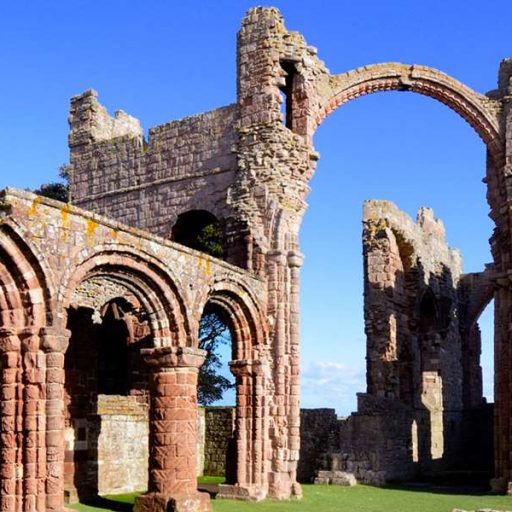
The final destination is Lindisfarne, Holy Island. Here, in AD 635, St Aidan founded the monastery that became one of the great centres of early Christianity in Northumbria. From this small island community, missionaries travelled across the North, establishing churches and monasteries and transforming the spiritual landscape of the region. St Cuthbert later became prior and bishop here, and the island remained at the heart of the Northumbrian Christian tradition.
After 240 miles, the journey ends where so much of the story began. The pilgrim can look back across the Way — from Antei-ji and the living practice of Zen, through the ancient Christian foundations of Lancaster and Heysham, the medieval monasteries of Cumbria, Shap and Furness, across the Pennines to Throssel Hole, and then through Durham, Minsteracres, Hexham and the landscape of St Cuthbert.
At Lindisfarne the monastery founded by Aidan has long since passed into history, but the island remains a place of pilgrimage. For those wishing to remain a little longer, there is also the option of spending two nights at Marygate House, allowing the journey to end not simply with arrival, but with time to be still.
The Way is complete. But perhaps your pilgrimage is only just beginning.