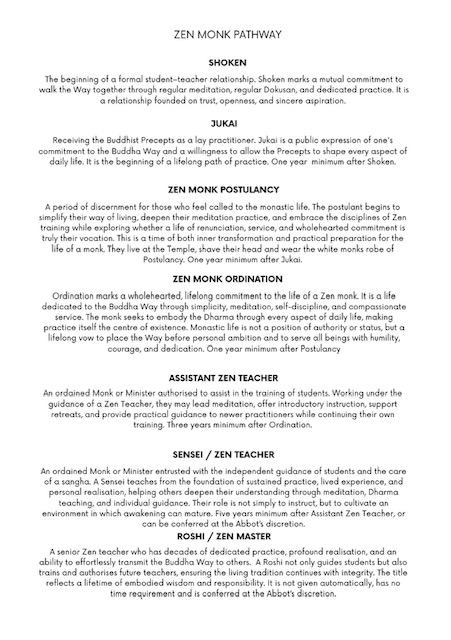
Two Training
Pathways
As our practice unfolds over time a very beautiful thing starts to happen, compassion and love for others becomes fixed in our life. Sometimes this can be the start of a wonderful journey of service to humanity and to the world. If that call to service is strong in you then one of these two pathways may be for you.
The call to service can be the most rewarding thing that a person can feel in their life. Our pathways are designed so that nobody who feels that calling will be discriminated against.
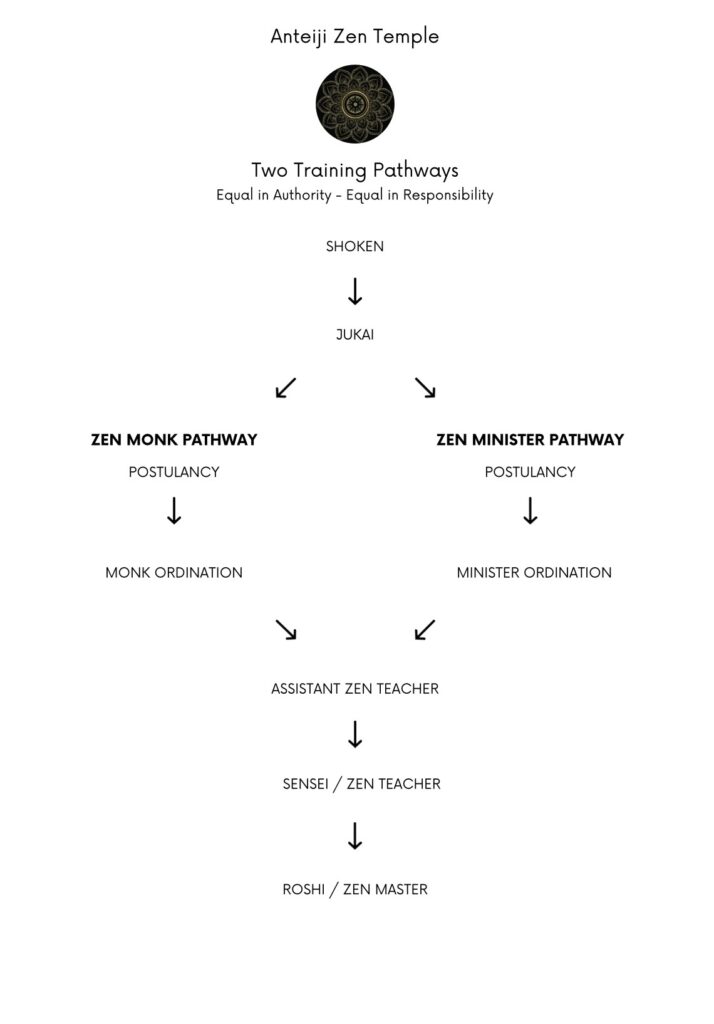
Zen Minister Pathway
At Antei-ji, the term Minister is used as a gender-inclusive term for all ordained Ministers.
At Antei-ji a Zen Minister is someone who has publicly vowed to live the Buddha Way in the midst of ordinary life. Their primary ministry is not found in particular duties or roles, but in the deepening way they embody the Dharma through their own life. This will happen in their relationships, their work, and their daily lives, recognising that every encounter offers an opportunity to meet another human being with wisdom, kindness, and respect.
Some Zen Ministers may be called to serve as the bedrock of the wider community. That could be through supporting someone through bereavement, leading meditation, visiting a hospital, conducting a funeral, engaging in a prison, offering spiritual companionship. In other words, being the bedrock of the wider community.
Others may be called to serve as the bedrock of the Sangha. To quietly devote themselves to zazen and the Dharma, rarely taking on any public role.
Both are equally valid expressions of Ministry. There is no ‘one size fits all’ way of being a Zen Minister. What remains important throughout all Zen Ministers however is a dedicated commitment to training and a lifelong vocation of service. This is an ordination in the true sense of the word.
Zen Ministers at Antei-ji may be married or single, raise families, pursue ordinary careers, and contribute to society in countless different ways. Their practice is not separated from everyday life but woven into it, the Minister seeks to express the same qualities of presence and compassion cultivated through zazen.
The role of a Zen Minister calls for emotional and personal maturity, humility, integrity, and a willingness to accompany others through every stage of life. Their training therefore extends far beyond the study of Buddhism. It includes the development of character, the cultivation of attentive listening, ethical responsibility, and the ability to remain grounded in the midst of both suffering and celebration.
At Antei-ji, the title of Rev is conferred upon a Zen Minister. Ordination, however, is not a recognition of attainment, but the public expression of a lifelong vow to continue practising for the benefit of all beings.
At ordination the Minister takes up the formal lay robe, to be worn as and when they think is appropriate.
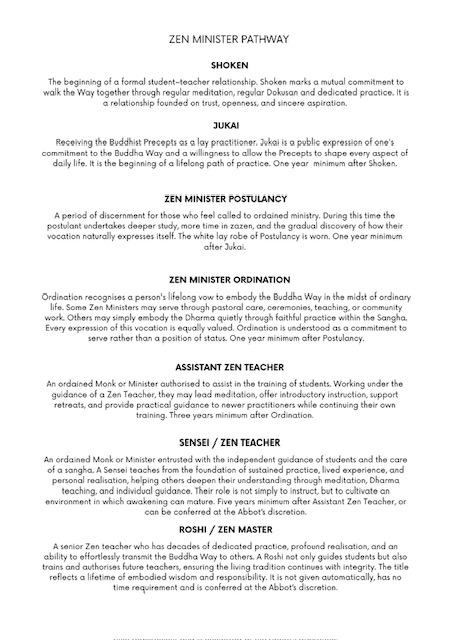
Zen Monk Pathway
At Antei-ji, the term Monk is used as a gender-inclusive term for all ordained monastics.
At Antei-ji, monks form the practice heart of the temple. Their wholehearted commitment helps create an environment in which the Dharma can flourish for everyone who enters. Their lives offer a living example of simplicity, dedication and of preserving the depth of the tradition while allowing it to grow naturally within contemporary society. They are the anchor of Antei-ji.
The Zen Monk is called to a life of wholehearted dedication to the Buddha Way. This is done through meditation, discipline, work, and compassionate service, the monk cultivates a simple life in which every action becomes an expression of practice. From the meditation cushion to the garden, from preparing meals to caring for the temple, every aspect of daily life offers an opportunity to awaken to the present moment and to embody the Dharma.
The monastic vocation is rooted in vow. It is a commitment to place practice at the centre of one’s life, allowing wisdom and compassion to mature through years of steady training. At Antei-ji, monks live within the temple. The rhythm of their meditation and service provides the foundation upon which their lives are built.
The training of a Zen Monk is both demanding and deeply rewarding. Over time, they learn that lasting transformation arises through returning again and again to this breath, this step, this moment. The discipline of monastic life gradually becomes a source of freedom, stability, and joy.
The Zen Monk walks the path not only for personal awakening, but for the benefit of all beings. Their steady commitment to the Way helps create an environment in which the Dharma can flourish, offering future generations a living example of wholehearted Zen practice.
At Antei-ji the title of Rev is conferred upon the Monk.
At ordination the monk shaves their head and takes up the Kesa (the Buddhas Robe).