The KAIHO-GYO
34,500 Mile
Peace Pilgrimage
The Seven Year
Peace Pilgrimage
of a
Marathon Monk
If you commit to nothing,
you will be distracted
by everything.
Kaihōgyō is a disciplined walking pilgrimage undertaken over long hours and repeated days and over SEVEN years, in all weathers and all states of mind.
It is the act of a simple monk doing the only thing that he can, holding up a mirror to the world. Humanity is always searching for something, and yet that ‘something’ is always here in this very moment.
On the pilgrimage, fatigue, resistance, boredom, fear, and doubt are not obstacles but the walk itself. Step by step, the habit of negotiating with life is exhausted. What remains is simple obedience to the ground beneath the feet and the vow that carries the body forward.
Walking simply becomes walking. What is revealed is not a special state but a deep ordinariness. The mirror revealing what the world is searching for.

LANCASTER CEMETERY
Seven Years
34,500 Miles
1050 Days
The 7-year Kaihogyo
season is from
1st March to 29th July
FIRST YEAR
- 26 miles of walking meditation for 150 consecutive days. 3900 miles. 1st March to 29th July
SECOND YEAR
- 26 miles of walking meditation for 150 consecutive days. 3900 miles.
THIRD YEAR
- 26 miles of walking meditation for 150 consecutive days. 3900 miles.
FOURTH YEAR
- 30 miles of walking meditation for 150 consecutive days. 4500 miles.
FIFTH YEAR
- 30 miles of walking meditation for 150 consecutive days. 4500 miles.
- Followed by DOIRI, a 7 day/night intense solitary meditation retreat sat in Zazen, in the cemetery without any food, drink, sleep or rest.
SIXTH YEAR
- 40 miles of walking meditation for 150 consecutive days. 6000 miles.
SEVENTH YEAR
- 52 miles of walking meditation for 150 consecutive days. 7800 miles.
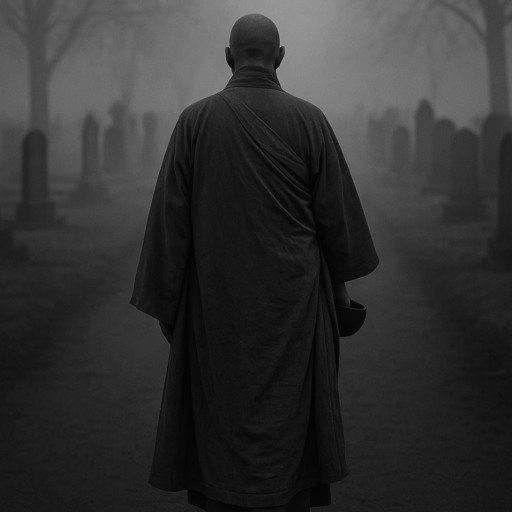
Our own Kaihogyo mountain is the 18 acres of Lancaster Cemetery. This is our sacred place. This is home. It is also a very appropriate place for such a journey, a journey that takes one to the edge of life.
Each day a fixed distance is walked in the cemetery. On the same ground. Under the same sky. With no variation, with no escape. This is the Way of the Kaihōgyō. The distance itself is not important.
But it happens to be exactly the same length as the Gaza Strip in Palastine. A place where human beings are living and dying in ways most of us do not allow ourselves to fully see. We live in a culture that turns away, because the mind protects itself. It likes to keep the world at a distance.
Zen practice goes in the opposite direction. It removes distance. To walk the same path every day is to stop escaping into distraction. To continue when the mind resists, this is the training.
After a while, something shifts. The world is no longer “out there.” Suffering is no longer happening somewhere else. There is no separation between this step and the life of the world. This is why we have compassion for the suffering of the world, we feel it.
The monk walks within himself. It is a pilgrimage into who he is. On the route he leaves everything behind and yet can hear every blade of grass sing like a songbird.
The cocoon of the monk starts to open as he walks with lightness and compassion. The walk takes him through the cemetery and also through the urban areas of central Lancaster. In doing so the monk walks through the humanity of his local area. Becoming one with his journey and his life, he walks for the benefit of all humanity.
A Word From Jitei
Why Am I Doing It?
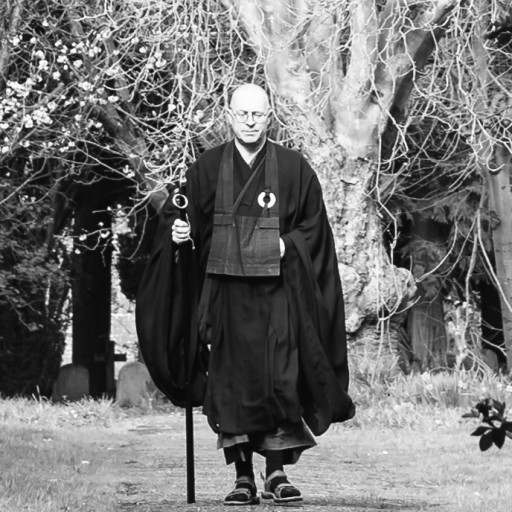
I walk to be a mirror, nothing more.
I walk because the world is in pain. Humanity is lost in this seeming never ending journey of status, of looking outside of ourselves for answers, of never ending conflict.
My life is to mirror this back to you.
I walk because the spiritual path does not unfold in moments of clarity, but in the slow erosion of self over years. To continue every day, especially when life is tough, day after day, through all weathers, through grief, boredom, illness and doubt requires absolute single minded dedication.
I began the Kaihōgyō in 2025, my 60th year. I am the oldest person to have ever started it and the only person outside of Japan in over a thousand years to have attempted the full seven years. I say this without any suggestion of gloating but as an act of offering.
If this serves as any sort of inspiration to you, let it be this: No matter what your own path in life is, you don’t have to be small. Live your life to the fullest of your ability. Walk it fully, while there is still ground beneath your feet.
Kaihogyo history
We need to make it clear that we are not representing the beautiful and ancient Tendai tradition. When thinking of the Kaihogyo what usually comes to mind is walking around the mountain of Mt Hiei, the home of Tendai in Japan. Kaihogyo literally means ‘to go around the peaks’. was first practiced by the great Tendai monk So-on on Mount Hiei in the 850’s in Japan. But it wasn’t until 1583 that the 1000 day pilgrimage that we know of today was fully formed.
The marathon monks, or Gyoja, walk (some run), in straw sandals and dressed in pure white robes, which is the colour of death in Japan. The walk is on the set path up and around Mount Hiei.
The journey begins at 1:30am each morning for the 19 mile route, stopping at 255 places of worship along the way to say prayers. Depending on the weather and the pace the monk will return to the temple at between 7:30 and 9:30am. After a service at the temple the monk can then eat, which is quite a meagre offering of tofu and rice, very different to the diet of a modern extreme athlete.
Most monks suffer in the first few weeks, with fever, pain in the feet, back and hips. By the 30th day the worst is over and by the 70th day they are fully in their stride. The first three years can be seen as basic training. Years four and five the pace steps up considerably.
After completing year five, the Gyoja faces the greatest trial of all; the Doiri, nine days without food, water, sleep or rest. The aim is to bring the adept face to face with themselves. it is a solitary retreat in the temple with only two other attendants whose job it is to nudge the monk if he starts to sleep, this happens 24hrs a day. On completion of the 9 days the Gyoja emerges as Tgyoman Ajari, “Saintly Master of the Severe Practice”.
The route lengthens during year 6 to 37 miles per day. The seventh and final year sees a further increase to 52 miles per day for 100 days, the equivalent to two marathons per day.
After competing the full seven years the Gyoja is now called Daigyoman Ajari, “Saintly Master of the Highest Practice”, and is regarded as a Living Buddha.